

Free images tag: Indexing
AI Bots Scraping your Content?
Search Engines July 6, 2024 0
What is GoogleOther and why does it visit my website?
Mozilla/5.0 (Linux; Android 6.0.1; Nexus 5X Build/MMB29P) AppleWebKit/537.36 (KHTML, like Gecko) Chrome/125.0.6422.175 Mobile Safari/537.36 (compatible; GoogleOther)The User-agent with GoogleOther, from AS15169 GOOGLE, looks like it is one of those Google bots you should welcome to your site?
AS15169 GOOGLE
A Google-owned block that can source official Google traffic, but why are they not using their usual Google/bot UA?
Because this is no ordinary bot, well it is, but what happens to the pages the GoogleOther bot scrapes from your site?
AI LLM
Google is in the race to build large language modes for their AI bots and the language comes from your website. The GoogleOther bot scrapes your site for inclusion into its Bard or whatever LLM they are building next.
Block
There is no legitimate need for GoogleOther to visit your site; this is not any of the usual Google indexing bots they use to run their Google search engine.
And will it help me with SEO for my site?
An "About Me" page can be important for SEO (Search Engine Optimization) and overall website performance. Here are some reasons why:
Relevance and Trustworthiness
Search engines, like Google, aim to provide users with relevant and trustworthy results. An "About Me" page provides essential information about the website owner or the team behind the website. This information helps establish credibility and trust with visitors and search engines alike.
Content for Search Engines
Search engines favor websites with valuable and relevant content. An "About Me" page can provide unique content that describes the website's purpose, mission, and values. This relevant content on your site can positively influence your rankings in search engine results.
Keyword Opportunities
When creating an "About Me" page, you can naturally incorporate relevant keywords related to your website's niche or industry. This can help improve the page's visibility in search results for those particular keywords.
User Engagement and Experience
A well-crafted "About Me" page can engage visitors and encourage them to spend more time on your website. This increased user engagement signals to search engines that your website is valuable and relevant, potentially improving rankings.
Backlink Attraction
An "About Me" page can also attract backlinks from other websites. High-quality backlinks from reputable sources are essential for SEO as they indicate to search engines that your website is authoritative and worth ranking higher.
Navigational and Indexing Importance
An "About Me" page makes your website more user-friendly and easier to navigate. Search engine crawlers also use internal links to discover and index content on your website. An "About Me" page with internal links to other essential pages on your site can help search engines find and index those pages more effectively.
Factors
However, it's essential to remember that while an "About Me" page can positively impact your SEO efforts, it's just one of many factors that influence search engine rankings. To achieve strong SEO performance, create high-quality, relevant, and valuable content across your website, including the "About Me" page. Additionally, ensure your website's technical aspects, such as site speed, mobile-friendliness, and proper use of meta tags, are optimized for search engines.
The Story of Google Search
Search Engines March 29, 2023 0
Google Search is the most popular search engine in the world, revolutionising how we find information. But how did Google Search come to be? What are its origins? And how has it evolved?
Google, the world's most widely used search engine, has become an indispensable tool for individuals and businesses. However, the story of Google's search engine is one of innovation, competition, and evolution. From its humble beginnings as a research project to its current status as a global powerhouse, Google's search engine has undergone numerous changes. This article will explore the story of Google's search engine from its inception to its dominance.
In this article, we'll look at the history of Google Search, from its humble beginnings to its current dominance. We'll also discuss some key features and innovations that have made Google Search successful.
The Story of Google Search
The story of Google Search begins with two Stanford University students, Larry Page and Sergey Brin. In 1996, they began working on a research project called BackRub, designed to rank websites based on the number of links to them.
BackRub was an instant success, and it quickly became one of the most popular search engines on the web. In 1998, Page and Brin founded Google, Inc., and they began commercialising BackRub.
In 1997, Larry Page and Sergey Brin registered the domain name "Google.com" and officially launched their search engine. The name "Google" is derived from the word "googol," which refers to the number 1 followed by 100 zeros, a nod to the vast amount of information on the internet.
Google Search was founded in 1998. The company's mission is to "organize the world's information and make it universally accessible and useful."
Initially, Google was a bare-bones search engine that focused on providing the most relevant search results. The interface was simple, with a single search box and a list of search results. However, Google's search algorithm was far more sophisticated than its competitors. By analyzing the links between web pages, Google 'ranked' search results based on their relevance and importance.
Growing Pains:
Google's Early Competition
Despite its initial success, Google faced stiff competition in the search engine market. Companies like Yahoo and AOL had already established significant market share, and new competitors like Ask Jeeves and Lycos were emerging.
In the early days of the internet, there were a number of search engines competing with Google. Some of the most popular early search engines included:
- AOL Search
- Yahoo! Search
- Alta Vista
- Lycos
- Excite
- Ask Jeeves
These competing search engines were all based on traditional methods of indexing websites, such as using keywords and meta tags. However, Google revolutionised the search engine industry by using a new algorithm called PageRank. PageRank is based on the idea that a website's importance is determined by the number and quality of other websites that link to it. This algorithm allowed Google to produce more accurate and relevant search results than its competitors.
In addition, Google was also one of the first search engines to index images and videos. This allowed users to find information on a much wider range of topics.
Popular
Google Search quickly became the most popular search engine in the world and has remained so ever since. This is partly due to Google's innovative search algorithm, which ranks websites based on various factors, including the number of links to them, the relevance of the content, and the site's popularity.
Google's search algorithm quickly gained a reputation for providing more accurate and relevant search results than other search engines. As a result, users flocked to Google in droves, and the company quickly became the go-to search engine for people around the world.
Google Search has also benefited from its user-friendly interface and its wide range of features. For example, Google Search allows users to search for specific terms or phrases, and it also provides a variety of filters and tools that can be used to refine search results.
Dominant
By the early 2000s, Google had become the dominant search engine on the internet, with a market share of over 90%. Its success was due to its superior technology and focus on the user experience. Google's simple, uncluttered interface and fast response times made it easy for users to find the information they were looking for quickly and efficiently.
As Google's popularity grew, so did its ambitions. The company began to expand into new areas, such as email (Gmail), maps (Google Maps), and video sharing (YouTube). It also developed its web browser, Chrome, which quickly became one of the most popular browsers on the market. Google produced the Android operating system that gives a huge boost to the capabilities of mobile phones.
However, Google's dominance has not come without controversy. In recent years, the company has faced increasing scrutiny from regulators and critics who accuse it of abusing its market power and violating users' privacy. Some have called for the company to be broken up or regulated more tightly.
Challenges
Despite these challenges, Google remains one of the world's most successful and innovative companies, with over $1 trillion in market capitalisation. Its search engine continues to be the most popular on the internet, with billions of searches conducted daily. And with its focus on innovation and user experience, it seems likely that Google will continue to be a dominant force in the internet and technology industries for many years.
Google Search has evolved, but its core mission has remained the same. Today, Google Search is the most popular search engine in the world, and it is used by billions of people every day.
In addition, Google Search has been at the forefront of the mobile revolution. The Google Search app is one of the most popular apps in the world, allowing users to search for information on the go.
The Future of Google Search
Google Search is constantly evolving and will likely continue to be the most popular search engine in the world for many years. In the future, Google Search may become even more personalized, and it may also be able to understand natural language more effectively.
Innovation in recent years, with new technologies such as machine learning and artificial intelligence, plays an increasingly important role in its search engine. These technologies allow Google to understand the meaning behind queries and deliver users more personalized and relevant results.
Google Search is also likely to continue to innovate in terms of its features and functionality. For example, Google Search may one day provide users with real-time information about their surroundings, or it may be able to help users find information relevant to their interests.
New Challenges
Google continues to be the dominant search engine in the world. However, many other search engines are competing for market share, not limited to, but including:
- Bing
- DuckDuckGo
- Ecosia
- Seznam
- Yandex
These, and other search engines are all trying to improve their algorithms and features to compete with Google and take more of the internet search share for themselves.
Conclusion
Google Search is a powerful tool that has revolutionised how we find information. It is the most popular search engine in the world and will likely remain so for many years. Google Search is constantly evolving and will likely continue to innovate regarding its features and functionality. Many new ideas are being developed; one recent development that surfaced is called 'Bard'. Google's AI-powered chatbot is currently in a public testing phase.
Market Share
Google Search is not the only search engine on the market but it is by far the most popular.
In 2022, Google Search had a market share of 83.84%, followed by Bing with 8.88% and Yahoo! with 2.55% while DuckDuckGo is at 0.64%
This is in contrast to the previous year, 2021 when Google Search had a market share of 92.6%, followed by Bing with 3.1%, Yahoo! with1.6% and DuckDuckGo at 1.01%
Previously in 2020, Google search had a 92.17% share, Bing with 2.78% and Yahoo! with 1.6%
Features
Google Search is constantly evolving, and new features are constantly being added with other, unused or unloved features being quietly dropped.
Some of the most recent additions include:
- The ability to search for images using natural language. For example, you can now search for "pictures of cats" or "photos of the Eiffel Tower", and Google will return relevant results.
- The ability to translate text from one language to another. This is a valuable feature for people who travel or communicate with people from other countries.
- The ability to find information about businesses and organizations. Google Search can now provide information such as the business's address, phone number, and website. This can be very helpful when looking for a place to eat or shop.
- The ability to filter search results by date, location, and other criteria.
Warnings
It is essential to use Google Search responsibly.
Google Search is a powerful tool that can be used to find information on almost any topic. However, it is important to remember that Google Search is not always accurate. Many websites contain false or misleading information, and Google Search can sometimes return these results. It is important to be critical of the information you find on Google Search and verify it with other sources.
Tips
- Be sure to verify the information that you find on Google Search.
- Be careful about the websites that you visit.
- Do not click on links from websites that you do not trust.
- Do not share your personal information with websites that you do not trust.
- Be aware of the privacy settings on your Google account.
- By following these tips, you can help to protect yourself from online risks and use Google Search safely and responsibly.
But is the latest thing to storm the internet?
That would be ChatGPT the Large Language Model (LLM) Artificial Intelligent (AI) Chat Bot.
Why so clever but so unaware?
The ChatGPT has been trained on a huge amount of information found on the internet and gathered over 570GB of text. This all takes time and doesn't happen instantly. The crawling, indexing and then learning all has a time cost. So while the data is huge, it just can't keep its finger on the pulse.
Search Engines
Search engines can see the queries typed into it in real time. As questions are asked of a search engine, those questions are logged. A search engine can be much more up-to-date with trending queried events. While backed up by a large database of constantly updated information.
ChatGPT
The AI bot is great at answering some sorts of questions, particularly tech based things but it can go much further afield than that. If you have not tried to use the ChatBot then give it a go. The tool is no different to asking a search engine your question, but you may be surprised by the answer. Find the ChatGPT here. But there are other AI Chatbots that the public have access to other than the GPT. Google is trialling the bard chat (currently in testing) and Microsoft is incorporating AI into its search engine.
We asked ChatGPT this:
what is the date of your most recent store of information?
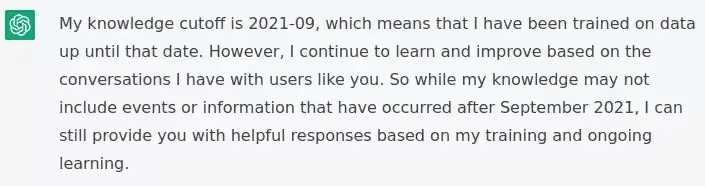
My knowledge cutoff is 2021-09, which means that I have been trained on data up until that date. However, I continue to learn and improve based on the conversations I have with users like you. So while my knowledge may not include events or information that have occurred after September 2021, I can still provide you with helpful responses based on my training and ongoing learning.
https://chat.openai.com/chat
Not only Chat
While the AI Chat is something to be seen another revolution is happening around us. That is AI Art. The AI bot has learned to paint, draw and charcoal to bring you on demand - high-quality art from just a few written words.
See our post on AI-generated awesome free images to see what the fuss is all about and have some fun creating art from the text.
Getting indexed by Google
Search Engines February 26, 2023 0
You have a website and you want it to appear on the google search engine.
This is a very common request and some are more successful than others in getting their website added to the big G.
Great Content
You have great content, but there is more to engaging with google than just your unique and informative content. Adding these necessary features are quite simple but can easily be overlooked when building a new site.
Add these
There are a few things to add to a new website to improve the chances that google will want to index your site.
About Us Page
Make a new page to act as your 'About Us' information post. Add a little bit or a lot of information to your new about us page that google can see and learn about you.
Contact Us Page
Adding a 'Contact Us' page will send the right signals to Google that you are a professional outfit that can be contacted. A contact form is a popular choice and can filters spam contact with a plugin like Akismet for wprdpress.
Privacy Policy
Adding a Privacy Police my be a legal requirement for the country you are hosting in, living in or the country you expect your visitors to come from.
- GDPR (European Union)
- UK-GDPR, PECR, Data Protection Act (United Kingdom)
- General Privacy Guidelines (United States)
- PIPEDA (Canada)
- Privacy Act 1988 (Australia)
- POPIA (South Africa)
- LGPD (Brazil)
Different regions have their own take on the privacy/cookie laws.
There a number of wordpress plugins that can handle the bulk of the privacy for you, we like Complianz for wordpress sites.
If you want to serve ads on your website to generate an income then we recommend the privacy policy service from Ezoic. While the ezoic service is centred around monetising your website with Advertising, it does include some awesome free addons like their Privacy Policy solution. Their privacy works with all websites and no plugins are required.
Add a Menu
Adding a menu will make it easy for your visitors, including the google bot to navigate your site. Without a menu the search engine crawler will struggle to see all your sites pages and may consider the site to be of low quality content.
More than content
Getting on the right side of the search engines needs more than just great content. It needs to be accessible to all, easy to navigate and the site should provide an enjoyable experience. Adding the extra pages for about, contact and privacy will all send good signals to the visiting crawlers to encourage their return.
Bing Not Indexing Site
Search Engines February 25, 2023 0
The site has been well received by google, you have top placements from the big G and you must admit that google loves you. On the other hand, Bing! is not a fan, it doesn't see any value in your site and considers it spam.
Sounds familiar?
Knock Knock
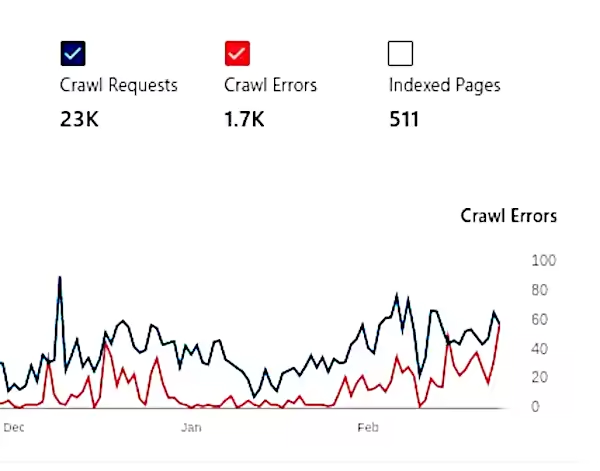
Check that Bing can see your site. Although google is allowed through your website security, it may be a different story for Bing. The Microsoft search bot is quite abusive and it can get itself blocked at times. Use these Bing Webmaster tools to check you are not seeing as many bing errors as crawl requests. You will see some, if not quite a few bing errors. The important factor is more successful crawler hits than fails.
Jump through hoops
None of it makes any sense, If the biggest search engine on the planet loves your content then why is Bing so difficult to please?
Have you reached out to the bing support? You should do this to ensure they can't give you a reason. They will send you links to follow about providing great content, making your site easy to navigate and reduce the number of ads above the fold. Well, google is happy with your site so it won't be due to the basics at fault.
Hopefully your interaction with bing! support will be fruitful and give you something to try. Exhaust their suggestions and reply politely to their emails. I got this far and things didn't improve.
Blacklisted
Bing had blacklisted the site and this had a knock on effect with the other search engines that piggy-back from Microsoft's Bing. Not a huge factor in itself but it is annoying that bing is just wrong which can be proved if google is correct.
Go all in
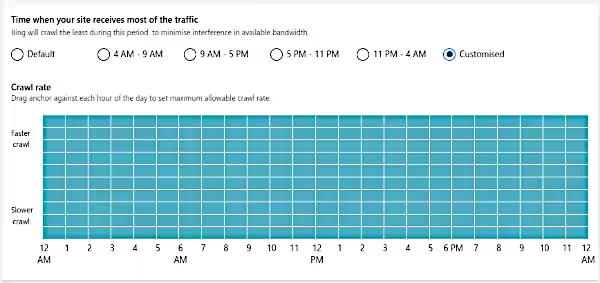
With confirmation that the crawler can access your site successfully and microsoft staff fully exhausted their advice and every suggestion enabled the next step was to go all in. The only way I could convince bing that the site was worthy of inclusion was to make sure the crawler could see every single page I had written.
Invoke Max crawl rate.
Index Now!
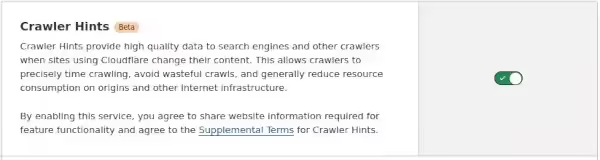
If your site is using cloudflare there is the option to enable 'IndexNow! - Crawler Hints' in the bing webmaster tool. It generates a fair bit of dross, but it's free and helps send good signals to bing from cloudflare about your site.
Time
After months of waiting. The bing started to show results. During this time the crawler was all over the content with its rate set to the max. Cloudflare crawler hints was working away doing good things. The graph show when the search engine decided it would be a good idea to index the content that google has acknowledged for years.
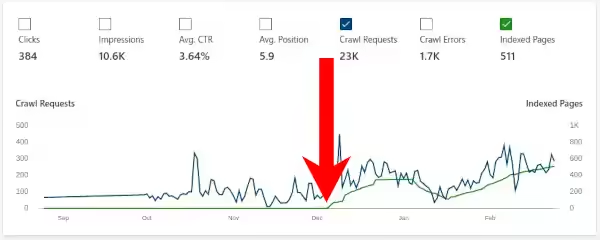
Up until the red arrow, bing indexed pages (green line) are zero. After the red arrow pages are steadily being added to the search engine.
A drop-off happens, but it recovers.
Something changed to enable bing to add the site. To the left of the red arrow show the blue line rather flat and steady until the max crawl rate was set. More crawls can be seen by the peaks of blue. These blue peaks are bing learning about the site, seeing how great it is and considering the addition to the index. When the decision is made to add the site you can see the green line pick up and take off.
Mission Accomplished
Bing search is now showing results that come from the site. Just as it should have always been, but for whatever reason the engine was stuck in a (sad face) mode. Giving the crawler a kick and allowing it plenty of time seemed to do the trick. While this is only a guess as to why things changed, they definitely did change and bing is now happily serving results from the site it was originally ignoring.